Engaging discussions at Circular Textile Days
October 1, 2026 – On September 30 and October 1, we attended the Circular Textile Days in Tilburg. We hosted a ‘TexConnect’ session, engaged with visitors at our booth alongside our partner SaXcell, and shared our joint vision on scaling up fiber-to-fiber recycling with the press in attendance. The central question was: where in the textile value chain do the greatest opportunities lie to accelerate the transition toward a circular textile industry?
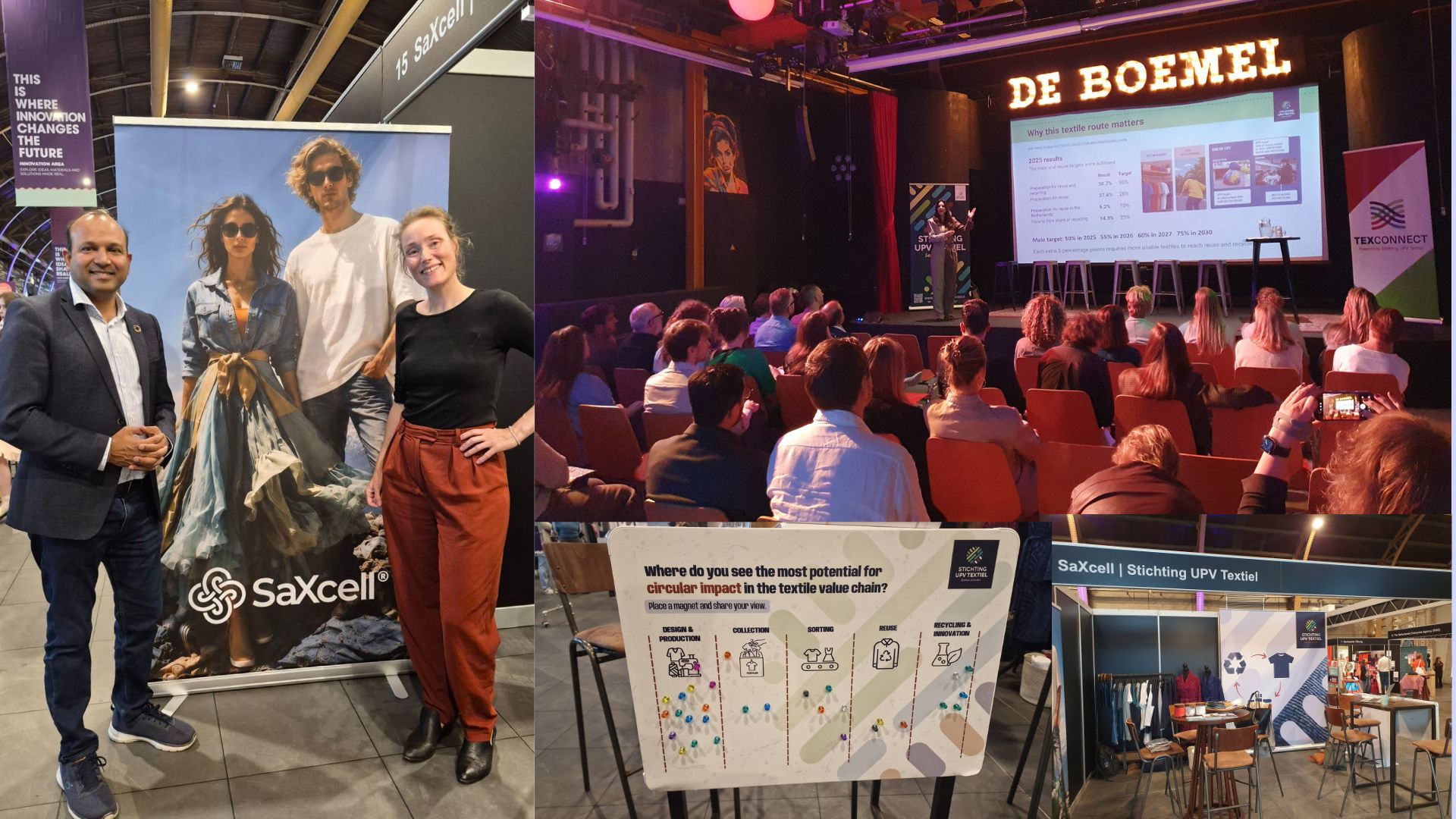
During the TexConnect session on September 30, our Participant Manager, Daphne grote Punt, guided the audience through the journey a discarded pair of jeans takes after being dropped into a textile collection bin. Together with experts from Het Goed, Wolkat, Vodde, SaXcell, and Regain, the discussion highlighted where value is lost within the chain and what is required to keep textiles suitable for reuse and recycling for longer. The audience was also invited to contribute their own thoughts, practical experiences, and ideas.
We continued this conversation at our booth, where visitors used a magnetic board to indicate which stage of the value chain they believe holds the most potential for circular impact. Design and production emerged as key areas. Many visitors noted that circularity begins at the design phase: by making deliberate choices regarding materials and design, a product can be more easily reused or recycled later on.
This connection between the various stages of the value chain is essential for advancing fiber-to-fiber recycling. Consequently, during the Circular Textile Days, we—together with SaXcell—conveyed a unified message: scaling up is only possible if stakeholders throughout the entire textile value chain work together. Ambitions and plans are important, but ultimately, it is in practice that we discover what works and what is required to achieve greater volumes.
For this reason, we have launched a practical pilot in which clothing brands, manufacturers, recyclers, and other supply chain partners collaborate to repurpose discarded textiles from the Netherlands as raw material for new textile products. SaXcell is one of the partners in our network, contributing expertise in the chemical recycling of cotton-rich textiles. By bringing together stakeholders and solutions from various stages of the supply chain, we aim to determine what is needed to scale up fiber-to-fiber recycling—thereby giving an increasing amount of discarded textile waste a new life in new textile products.
The Circular Textile Days provide us with valuable insights and new connections. The conversations held during TexConnect and at our stand demonstrate the wealth of knowledge, experience, and ideas present within the supply chain—and highlight the importance of bringing these elements together. As the second day of the event continues, we look back on many inspiring encounters and look forward to the collaborations that may emerge from them. We look forward to continuing the conversation—both at the next edition and, most importantly, in practice.