National campaign for textile collection
3 November 2025 – The national public campaign ‘Niet dumpen, wel droppen‘ has officially launched. With this multi-year campaign we, as a foundation acting on behalf of more than 1,100 producers and importers, aim to encourage people in the Netherlands to adopt a more circular approach to textiles. Every year, more than half of discarded textiles end up in residual waste. As a result, valuable materials are lost for reuse and recycling – what a waste! The Niet dumpen, wel droppen campaign makes textile collection easy, clear, and positive.
Texxie: the guide to better textile habits
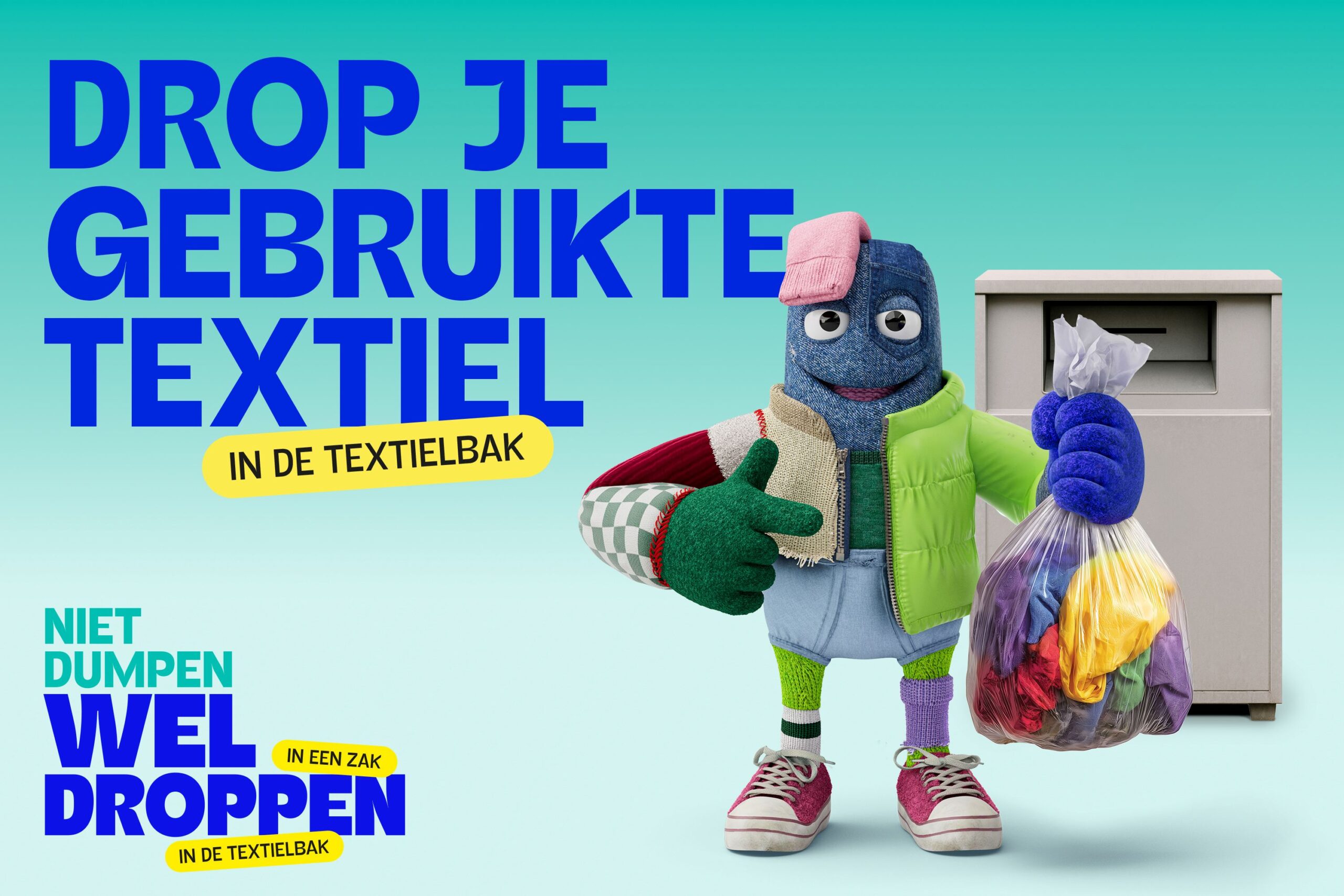
To inspire behavioural change, the campaign introduces Texxie – a friendly and recognisable character who guides consumers in a light-hearted and motivating way through the world of textiles. Texxie shows that all textiles, even damaged or worn-out items, have value and deserve a second life. The message is simple: bring all your textiles, even if they are torn or threadbare, in a closed bag to a textile bank, charity shop, or other collection point. This way, textiles can be given a second life – either as clothing or as raw material for something new.
Become a supporter of circular textiles
Is your company active in the Netherlands? We invite you to support the campaign. Together, we can show our shared commitment to building a circular textile chain. You can get started right away via www.dropjetextiel.nl, where you’ll find a practical toolkit full of campaign materials.
Phased approach
The multi-year campaign will be implemented in phases until the end of 2028. In the first phase (from November 2025 through 2026), the focus will be on raising consumer awareness of separate textile disposal. From March 2026, the campaign will be scaled up nationwide with broad media coverage and PR activities. In the period following 2026, efforts will focus on achieving long-term behavioural change and establishing textile collection as the new norm.
EPR Textiles
The campaign forms part of the statutory Extended Producer Responsibility (EPR) for textiles. From 2025, producers and importers are required to collect at least 50% of all textiles placed on the market for reuse and recycling, increasing to 75% by 2030. Consumers play a vital role in achieving these EPR targets: by disposing of textiles correctly, more items can be reused or recycled.
More Information
Visit www.dropjetextiel.nl for further information and contact options.